Litchfield County Dog Registration Information
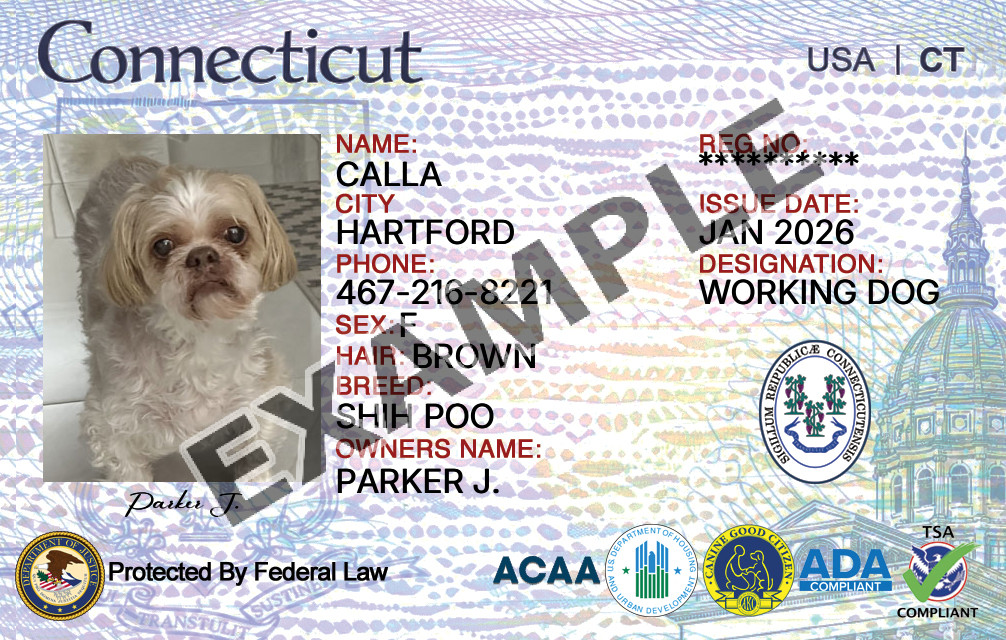
Service Dogs and Emotional Support Animals in Litchfield, Connecticut
If you’re searching where do I register my dog in Litchfield County, Connecticut for my service dog or emotional support dog, the key point is that dog “registration” is usually handled as a municipal dog license through your local town or city clerk (not a countywide registry). Litchfield County includes many different municipalities, and the exact process can vary by town, but the common thread is that most residents license dogs locally and provide proof of current rabies vaccination.
- There is no single universal federal “service dog registry” that you must use to make a dog a service dog.
- Emotional support animals (ESAs) are not “registered” by the federal government as a condition of being an ESA.
- Dog licensing is a local/municipal requirement in Connecticut and is separate from service dog or ESA status.
Where to Register or License Your Dog in Litchfield County, Connecticut
In Connecticut, dogs are typically licensed through the town/city clerk for the municipality where the dog is kept. Below are verified official offices that serve residents in Litchfield County, Connecticut. If you live in a different town than those listed, contact your own town/city clerk’s office for dog licensing requirements and forms.
Town of Litchfield — Town Clerk (Dog Licenses)
Notes: The Town of Litchfield Town Clerk’s office states dog licenses are obtained/renewed in June to avoid late fee penalties, and the dog licensing page notes licensing becomes due for issue and renewal each June by state statute, with in-person hours listed above.
City of Torrington — City Clerk’s Office (Dog Licensing)
Notes: Torrington’s dog licensing page indicates renewals occur during a June renewal period and lists the City Clerk’s phone number and the City Hall mailing address for new registrations by mail.
Town of Harwinton Regional Animal Control Department (serving multiple Litchfield County towns)
This office is an official animal control department that serves several towns in Litchfield County (including Harwinton, Litchfield, Morris, Winchester/Winsted, and New Hartford). Animal control is typically not the licensing issuer (that’s usually the town clerk), but it can be the right contact for animal welfare, strays, nuisance issues, and local enforcement questions.
Overview of Dog Licensing in Litchfield County, Connecticut
How dog licensing works locally
For most residents, a dog license in Litchfield County, Connecticut is issued by the town or city clerk in the municipality where your dog is owned or kept. Connecticut law and local town practices commonly require a license for dogs over a certain age (often 6 months), and many towns run an annual renewal cycle in June. In other words, if you’re asking where to register a dog in Litchfield County, Connecticut, the most accurate answer is: your local town/city clerk (not the county).
Municipality-by-municipality differences inside the county
Litchfield County includes many towns (and at least one city), and each municipal clerk’s office may have:
- Different in-person hours and accepted payment methods
- Different ways to submit (in person, mail, and sometimes online renewal)
- Slight differences in documentation requests for first-time licensing vs renewal
- Local late-fee cutoffs or reminders aligned with the statewide licensing cycle
If you don’t see your specific town in the office list above, contact your own municipality’s clerk for the official dog licensing requirements in Litchfield County, Connecticut as applied to your address.
What You Need Before Registering a Dog
Common documents and information requested
While requirements can vary by town, most municipal clerks ask for documentation that shows the dog is vaccinated and that you are the owner/resident. It’s common to prepare the following before you apply:
- Current rabies vaccination certificate (usually required)
- Owner identification (especially if applying in person)
- Proof of residence in the municipality (sometimes requested)
- Spay/neuter documentation (if you are licensing as altered; some towns require a veterinarian certificate for newly altered dogs)
- Dog details: name, breed, color/markings, sex, age, and sometimes microchip number (if applicable)
Rabies vaccination and public health
A current rabies vaccination is a core part of municipal licensing in Connecticut. Many clerks will not issue a license without proof of rabies vaccination. If your dog’s rabies vaccination is near expiration, you may want to update it with your veterinarian before submitting your application to avoid delays.
Steps to Register or License a Dog in Litchfield County, Connecticut
Step-by-step process (typical municipal workflow)
- Identify your correct licensing office: start with your town/city clerk where the dog is kept (for example, Town of Litchfield Town Clerk or Torrington City Clerk).
- Confirm timing: many Connecticut towns emphasize June as the annual licensing/renewal month. If you’re new to the town or your dog just turned the licensing age, ask if licensing must occur within a set number of days.
- Gather documents: rabies certificate, any spay/neuter proof, and any local form your clerk uses.
- Submit your application:
- In person at the clerk’s office during public hours, or
- By mail (some towns accept mailed applications with copies of required certificates and a return envelope), and in some cases
- Online renewal may be offered (often only if rabies data is already on file and current)
- Pay the licensing fee: fees commonly differ for altered vs unaltered dogs, and late fees can apply after a deadline.
- Receive your tag: keep the tag attached to your dog’s collar as instructed, and retain your paperwork for your records.
If you moved within Connecticut
If your dog was previously licensed in another Connecticut town and you moved into a Litchfield County municipality, ask your new town clerk how they handle transfers or re-licensing. Procedures can vary by town, so confirming locally helps you avoid late fees or duplicate steps.
Service Dog Laws in Litchfield County, Connecticut
Service dog status vs a dog license
A service dog is generally defined (under federal disability law) as a dog trained to perform specific tasks for a person with a disability. This is different from a dog license, which is a municipal requirement focused on vaccination, identification, and local compliance.
- Dog license (municipal): issued by your town/city clerk; typically tied to rabies proof and local fees.
- Service dog legal status: tied to disability-related need and task training; not created by obtaining a municipal dog license.
No single universal federal registry
If you are looking for “registration” specifically for a service dog, it helps to know that service dogs are not registered through one universal federal government registry in order to be legitimate. In daily life, what matters most is whether the dog is trained to perform tasks related to the handler’s disability, and whether the handler follows applicable access rules. Municipal dog licensing is still commonly required where you live.
Practical local tip
When speaking with a clerk or animal control dog license contact in Litchfield County, Connecticut, describe your situation clearly: “I need to license my dog in this town; my dog is a service dog (or in training, if applicable).” They can explain what documentation is needed for licensing (typically rabies/spay-neuter proof), while service dog status is usually handled under separate legal standards rather than a town-issued “service dog license.”
Emotional Support Animal Rules in Litchfield County, Connecticut
What an ESA is (and what it is not)
An emotional support animal (ESA) generally refers to an animal that provides comfort by its presence and may be recommended by a licensed healthcare professional as part of a person’s treatment plan. ESAs are different from service dogs because ESAs are not required to be trained to perform specific tasks.
ESA status does not replace municipal licensing
If you have an ESA and you live in Litchfield County, Connecticut, you typically still follow standard municipal licensing rules for dogs (rabies proof, licensing fees, tag). ESA status is separate from the town’s dog license and does not act as a substitute for local registration/licensing requirements.
Housing and documentation (general guidance)
Many ESA questions come up in housing contexts. Your local clerk’s office usually won’t “issue” ESA status. If you need ESA documentation for housing, that’s typically addressed through healthcare-provider documentation and applicable housing laws—not through the dog license process. For licensing, focus on the municipality’s requirements: rabies certificate, owner details, and any spay/neuter proof.
Dog License vs Service Dog vs Emotional Support Animal (Comparison)
The terms can overlap in everyday conversation, so the table below separates dog licensing requirements in Litchfield County, Connecticut from the legal concepts of service dogs and emotional support animals.
| Category | Dog License (Municipal) | Service Dog | Emotional Support Animal (ESA) |
|---|---|---|---|
| What it is | Local identification/registration required by many Connecticut municipalities for dogs kept in town. | Dog trained to perform tasks for a person with a disability (task-trained assistance). | Animal that provides emotional support/comfort; not necessarily task-trained. |
| Where you handle it in Litchfield County, CT | Your town/city clerk (e.g., Town Clerk or City Clerk where you live). | No single “registration office” creates status; legal status is based on disability-related need and training. | No single “registration office” creates status; commonly tied to healthcare-provider documentation (often for housing contexts). |
| Common documentation | Rabies vaccination certificate; sometimes spay/neuter proof; owner/residency details. | Typically not “papers” from a government registry; focus is on trained tasks and lawful conduct. | Commonly a letter/documentation from a licensed healthcare provider (context-dependent); not a town-issued license type. |
| Does it replace the other categories? | No—licensing does not “certify” service dog or ESA status. | No—service dog status does not automatically waive local dog licensing requirements. | No—ESA status does not replace municipal licensing requirements for dogs. |
| Why it matters | Compliance with local law, helps identify dogs, supports vaccination tracking, and can help reunite lost dogs. | Access and accommodation rights in specific contexts under applicable law. | Often relevant in housing accommodation contexts; not the same as public-access service dog rules. |
Frequently Asked Questions
What You May Need
Disclaimer
Local laws, fees, office locations, and contact details can change. Residents should verify the most current information with their local animal services or licensing office in Litchfield County, Connecticut.
Quick local reminders
- If you’re asking “where do I register my dog in Litchfield County, Connecticut,” start with your town/city clerk.
- A service dog or emotional support dog can still need a standard dog license in Litchfield County, Connecticut.
- When in doubt, call the office listed for your municipality and ask for the current requirements and any deadline details.
Register A Dog In Other Connecticut Counties
Select your county below to get started with your dog’s ID card. Requirements and license designs may vary by county, so choose your location to see the correct options and complete your pup’s registration.
- Capitol Dog License Cards
- Connecticut's eight historical counties Dog License Cards
- Fairfield Dog License Cards
- Greater Bridgeport Dog License Cards
- Hartford Dog License Cards
- Lower Connecticut River Valley Dog License Cards
- Middlesex Dog License Cards
- Naugatuck Valley Dog License Cards
- New Haven Dog License Cards
- New London Dog License Cards
- Northeastern Connecticut Dog License Cards
- Northwest Hills Dog License Cards
- South Central Connecticut Dog License Cards
- Southeastern Connecticut Dog License Cards
- Tolland Dog License Cards
- Western Connecticut Dog License Cards
- Windham Dog License Cards
